
Adaptive ladder
Bitrate ladder derived from the source, not from a preset table. Grain-heavy footage gets more; slides get less.
MediaLane takes your master, builds the adaptive ladder, and serves each rendition from the edge closest to the viewer. One API call in, a player-ready manifest out.
curl -X POST https://api.medialane.app/v1/assets \
  -H "Authorization: Bearer $MEDIALANE_KEY" \
  -d '{"input":"s3://masters/keynote-2026.mov",
       "ladder":"adaptive","audio":"opus"}'
The parts nobody wants to build twice — ladder, packaging, delivery, and the numbers that tell you it worked.
Bitrate ladder derived from the source, not from a preset table. Grain-heavy footage gets more; slides get less.
Every rendition served from the nearest region, with origin shielding and stale-while-revalidate by default.
The same manifest shape for both. Start a live channel, archive it, and the recording keeps the same asset id.
Startup time, rebuffer ratio and drop-off, broken down per variant instead of averaged into mush.
Ingest queue, ladder progress, delivery and quality — on a single screen, updated as encoders report in.
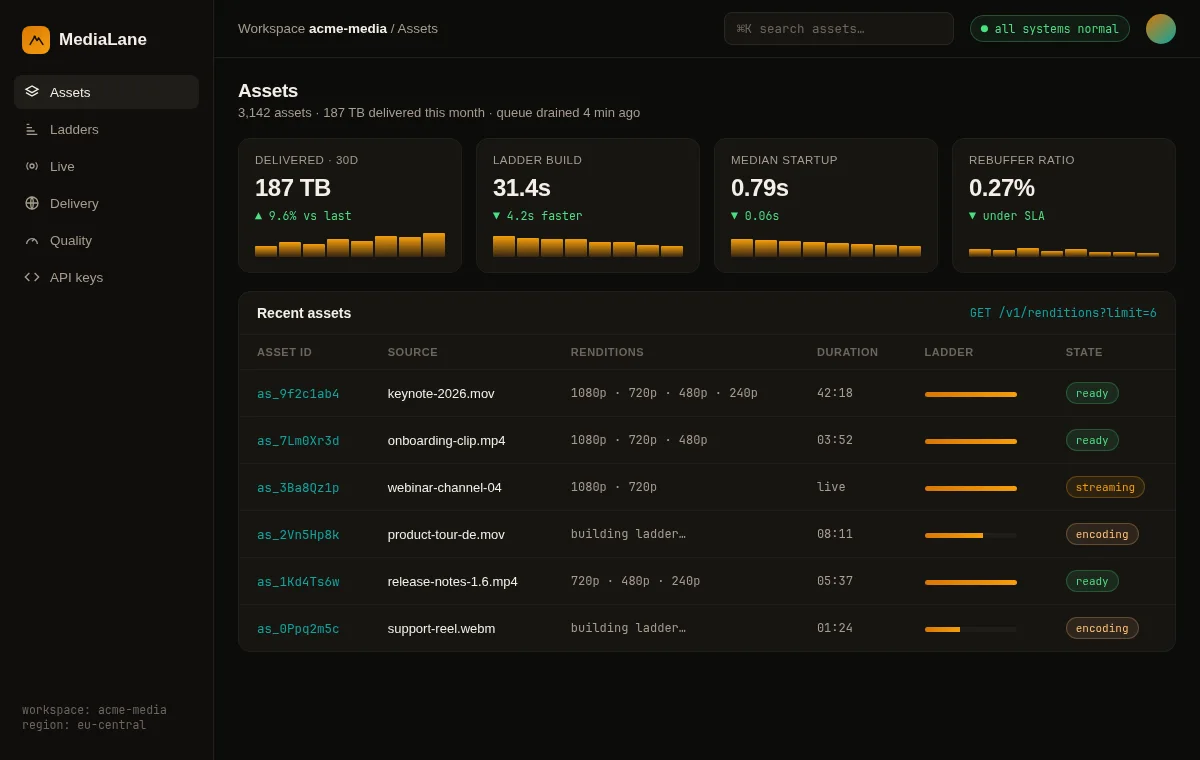
MediaLane console — assets and delivery, sample workspace
# ladder is built asynchronously — poll the rendition
GET /v1/renditions/9f2c1ab4e07d4c8fa1b3d65e08c47a12

200 OK
{ "state":"ready", "duration":2538,
  "variants":[ "1080p","720p","480p","240p" ] }
Signed URLs, per-key scopes, and an audit trail for every asset mutation. No surprises in the delivery path.
Median startup under a second across 41 regions, measured from the player, not from our own probes.
Everything the console does is a documented endpoint. SDKs for Node, Go, Python and Swift.
Free tier covers 100 GB of delivery and unlimited encodes on files under 10 minutes.
Start free Read the docs